
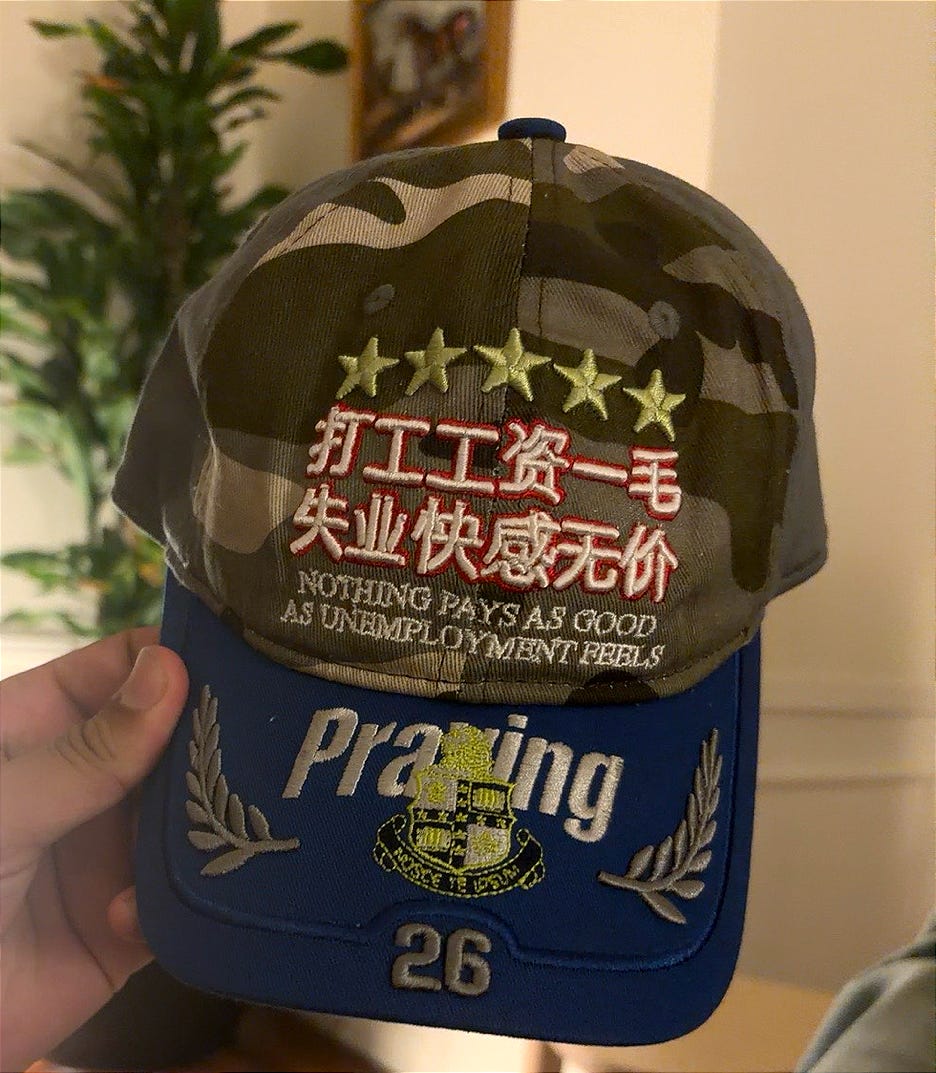
on employment
do you get the pun hahahahaha

It’s been eight months since I quit my job with absolutely no plan. I’ve flirted with the idea of being my own boss for years but usually end up being like, “oh I’m still young and money is sort of important I guess and I should try lots of different things and jobs are good for meeting people and learning from them” and then ending up at another job that I hate.
I was a teenager who was probably plugged in a bit too early. I was the only one of my friends with a summer job in grade 9 and 10, and in grade 11 I had an internship at a tech company. That same summer I started a dropshipping business that actually worked and skipped school to go to hackathons and tech networking events. Most kids skipped class to smoke weed in the bathroom but I as a man of culture was in the library writing Medium articles on AI.
It was no surprise to any of my longtime friends when I dropped out of college. School was never really my thing even though I really loved learning. I always thought it was stupid I was learning things I’d never use in the real world, and so I interned at Shopify throughout college while studying to learn how to code “for real”. I worked on a startup for a year after dropping out, and after getting laid off when I was 20, I realized it was the first time I’d ever have complete control of my time. No job, no school, just me and the hamster in my brain.
Three years later I’m kinda back at the same place. And it’s fucking terrifying.
Did you know that when you have no one else telling you what to do, no rubrics or KPIs, that you have to come up with it yourself?? And that when people at San Francisco parties ask you what you’re working on, if you say something like “not much just trying to take it easy” or “just chilling how about you” they’ll walk away and stop talking to you??
I know we’re in an all time hard-as-fuck job market for everyone and all, but that’s not why I’m terrified. I’m lucky enough to have enough money in the bank and all to weather the storm, but I’m fairly mid-career enough to know I could get a job if I really wanted. I’m just scared that so much of our world is set up on the idea that you do something you kinda maybe like only a little bit (if you’re lucky) and the big bad man pays you a little bit for it and we do that until we’re dead. Squidward told us about this years ago but it’s finally sinking in.
It blows my mind how much I felt a loss of my entire identity every time I quit a job and tried to figure out what to do with my life. Sometimes it ended up being another job - I went from software engineer to sales engineer to growth engineer to account executive to growth engineer again. That’s mostly chill.
But when I was making YouTube videos, I hated saying I was a YouTuber, because I felt like I wasn’t. I never made any money from it, never got more than 10,000 views, and there was no way to claim any identity without feeling like I didn’t deserve it. I had a TikTok get one million views - but I barely put any effort in that. Is there a certain view count that makes me a TikToker? I was writing Substack posts sometimes maybe three or four times a year - was I a writer?
There’s no easy identity to claim when you’re unemployed, other than being a bum. But it’s so easy when you’re employed, you don’t even have to think about it, it’s there on an official-looking piece of paper! I’m an engineer!
Say we get to a place where money is meaningless and all work is automated. Entirely possible future with the way AI is going. I can’t imagine what it’ll be like when everyone has to look themselves in the mirror and think about what they are outside of what they do for work. Sure, we’re also our bonds with people, but also there was a point in time where our names were literally our jobs (Smith, etc.) To look yourself in the mirror every day and figure out what you want to do even if it’s not economically productive is a future we’re not ready for. It’s shaking.
That’s kind of what I’m experiencing right now. I’ve spent most of my time writing SF Alexandria these eight months, and while I’d like to make money off it someday, I’m not actually that pressed about survival right now. I’m more worried about finding something I actually want to do, and I’m confident that if I believe in myself, the money will follow.
I wish that confidence was unfaltering but I’ve lost count of how many times I’ve wanted to give up at this point. It’s almost easier to give up on doing your own thing, because giving up actually means starting something, in this case a job. Which is what everyone else does anyway, and that’s why there’s so much resistance towards quitting a job. I see a million smart and capable people rationalize circles around themselves into staying somewhere they’re not entirely happy, because they’re right! It’s so easy to be unemployed and bum around playing video games all day. God knows how many months I’ve spent doing that. At least if you’re putting in the bare minimum at your job and bumming after hours, you can still say you’re being a productive member of society and have a script for social events.
Starting a new job? Good, you’re starting. Doesn’t really matter what you do there, you did it! It’s on a resume, you’re co-signed for future big bucks. Quitting a job?? You’re quitting? You’re a little quitter, aren’t you? That’s what it feels like in my head whenever I feel that all too familiar feeling in my chest that my latest career pivot actually wasn’t the dream I dreamt of as a boy in my room. In that room my ideas felt infinite and here I was, putting myself in another place trying to confine them in an office lined with free pseudo-healthy snacks and $1000 chairs that still hurt my back.
I keep asking myself why I do it, and part of the reason is probably because I enjoy the pain. Alysa Liu was onto something when she said, “I love struggling. It makes me feel alive.” But the other part of it is that, even through all the pain of feeling aimless and stupid and broke, all those shitty feels are new feelings. I hate that sinking feeling in my chest that arrives three, six, or twelve months into a new job, and having to put up with it until I feel the courage to take off my own golden handcuffs.
With a job, I know what to expect. Each one is different but there’s a certain space they exist in, and how I expect myself to be, and how others will be because this is a workplace where we work and these are my work friends. But I have no idea how good or how shit things can be when I’m truly in charge of everything. The search space becomes so much wider, to the point where I may be all over the place but at least the canvas is more filled out even if the picture isn’t as pretty.
More ideas:
I feel like active exploration is the way to go when you don’t know what to work on, and when you do just full on sprint and get into a routine where you leave as much time to work on it as possible. My best days are when I set one goal and try to hit it, then treat the rest of the day as gravy. My friend Farza does active exploration incredibly well.
Throughout his early years, he just built things inspired by what he liked. He liked gaming, so he made a bunch more gaming projects. That led to him working for TSM, a major esports team, doing data analysis, and later Visor GG, making an AI Overwatch coach. He never applied for a job. People just found him after he posted about projects he made for fun.
“When I was doing Buildspace, pretty much every time we came up with something, it’d just start with ‘wouldn’t it be cool if...?’ Before Nights and Weekends, we made courses teaching people about AI and crypto. But we thought, ‘wouldn’t it be cool if people who started with a course could keep working on their ideas after the course is done?’ After seeing everyone in Nights and Weekends make stuff on Discord, we thought, ‘wouldn’t it be cool if they came to San Francisco and met each other?’ For the school, it was like, ‘wouldn’t it be cool if they worked on their ideas full time?’”
He recently posted a demo on Twitter for a little AI friend called Clicky. It follows your mouse cursor around, points at stuff and you can ask it to help you with whatever’s on screen. People loved it, it went viral, then he shipped another demo the same week for a site that stores all of his information in a way that makes it easy for AI to use called Farzapedia. People loved that one too and paid him thousands of dollars to try it, yet he’s shelved it for now because it’s not interesting enough.
Creativity often feels like an abstract art. I hear people complain about not feeling inspired whenever they try to make something good. Like they’re waiting for lightning to strike but it’s just not hitting them. Farza’s somehow been able to come up with products and ideas that millions of people love, and watching him work, it feels anything but random. He’ll reference the moment in the Beatles documentary where Paul McCartney composes ‘Get Back’ in four minutes while waiting for John Lennon to come to the studio.
“People will look at that and say he had a sudden stroke of inspiration. But they won’t see the previous three months of him coming to the studio every day and coming up with nothing.”
—You can make something good, SF Alexandria
So does my friend Riley:
One of Riley’s biggest inspirations is this guy who makes $200k/year writing music that you’ve probably never heard of: Matt Farley. Matt’s been making about 50 songs a day for the past 12 years, but most of those songs barely get any streams. He’s written a book, produced short films, all of which have been seen by maybe a few hundred people total. But when you add up the impressions of his entire 20,000-song body of work, it starts to make sense why he makes that much money.
When asked about how he makes so much stuff, he said:
“If you reject your own ideas, then the part of the brain that comes up with ideas is going to stop. You just do it and do it and do it, and you sort it out later.”
One of his most elaborate pranks was Mehran’s Steak House. It initially started as a joke when his old roommate Danielle listed their group house as a steakhouse on Google Maps. The joke grew, getting over 100 detailed 5-star reviews from other friends pretending they’d eaten there. Being the only perfect 5-star steakhouse in NYC gave them a lot of attention, and after shooing away visitors from a restaurant that didn’t exist for two years, they thought “Wouldn’t it be funny if it actually did?”
That’s how a lot of Riley’s ideas start. “Wouldn’t it be funny to piss off the Qatari government? Or make a Gmail clone called Jmail with all the Epstein emails in it? Or Find My Friends but it tracks parking cops?”
—Training the idea muscle, SF Alexandria
I’m kind of a beacon for people quitting their jobs at this point. I’ve done it so often, and I know it’s scary to quit and go without income or purpose for a while, but it’s more scary for me to have the ideas I have bottled up in my head instead of out in the world. What I try to remind myself and other people is that you’re always choosing your hard.
As in, it’s hard to exercise, but it’s also hard being fat and lazy. At my past jobs, I could slowly feel my creative energy fading, and that slow drain hurt, so I just decided to stab myself and feel the sharp pain of quitting rather than letting the drain take me away. Also, after quitting, you can usually go back! From my post You’ll make worse decisions by thinking about them:
I’ve quit more jobs than my parents combined at 23, because I know that if I don’t like what I’m doing I’m living my worst-case scenario on purpose. As in, if I quit then try something new and it doesn’t work, worst-case my previous employer would probably take me back since I wasn’t fired for performance issues.
I can’t really argue that chasing your dreams is easier when you have a good amount of money saved up. But also, greater men than you and I have done incredibly difficult work for much less money than today’s white-collar jobs and lived for their dreams:
The American composer Philip Glass funded his music by starting various companies where he could work intensely for two weeks, then take two weeks off to write—a moving company, a plumbing business. After his international breakthrough, the opera Einstein on the Beach (1976), the 39-year-old Glass spent two years working as a cab driver in New York to pay off the debts from the tour. That is as good a way as any to do it.
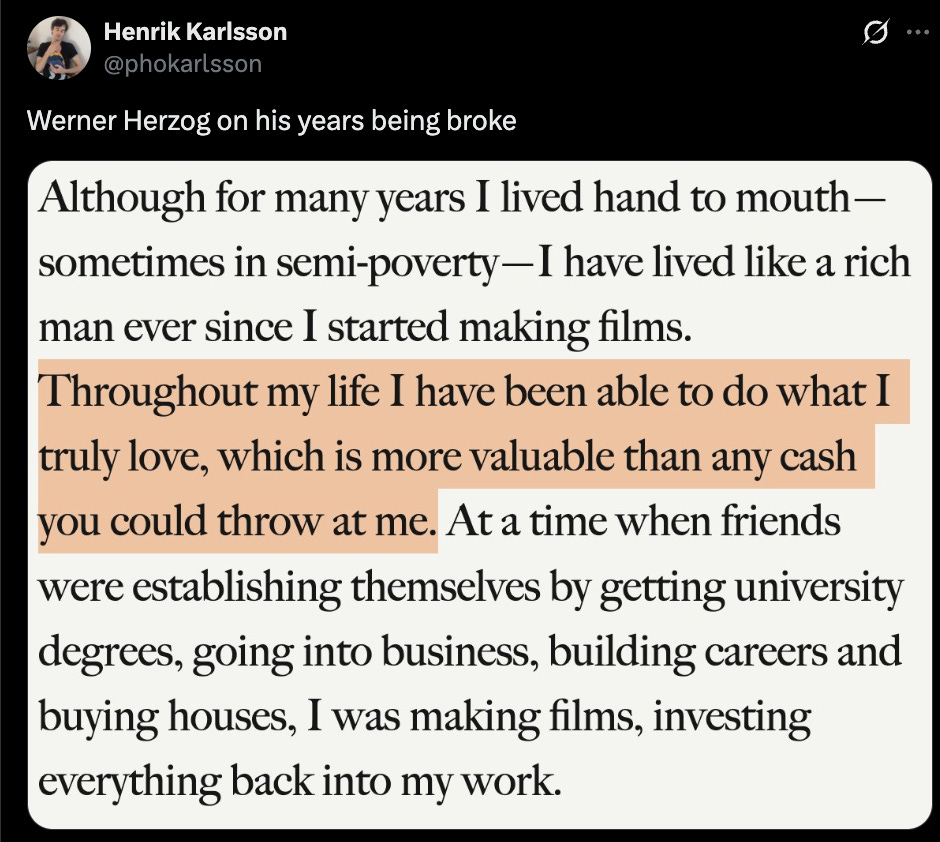
Herzog, after founding his company at 17, spent the final two years of high school working the night shift at a steel factory to save up money for productions.
I’m not sure if I’m as passionate as them, but I do think we need a lot less money to live a fun and fulfilling life than the nuclear family with a house and car and 2.2 kids American dream propaganda advertises. In my worst case, even before moving in with my parents, I’ll take my last $10,000 and live like a king in Shenzhen for a year. If I can’t make something work then, I deserve to go back to a job for a bit.
A renaissance man reading technology articles during the heights of Medium